
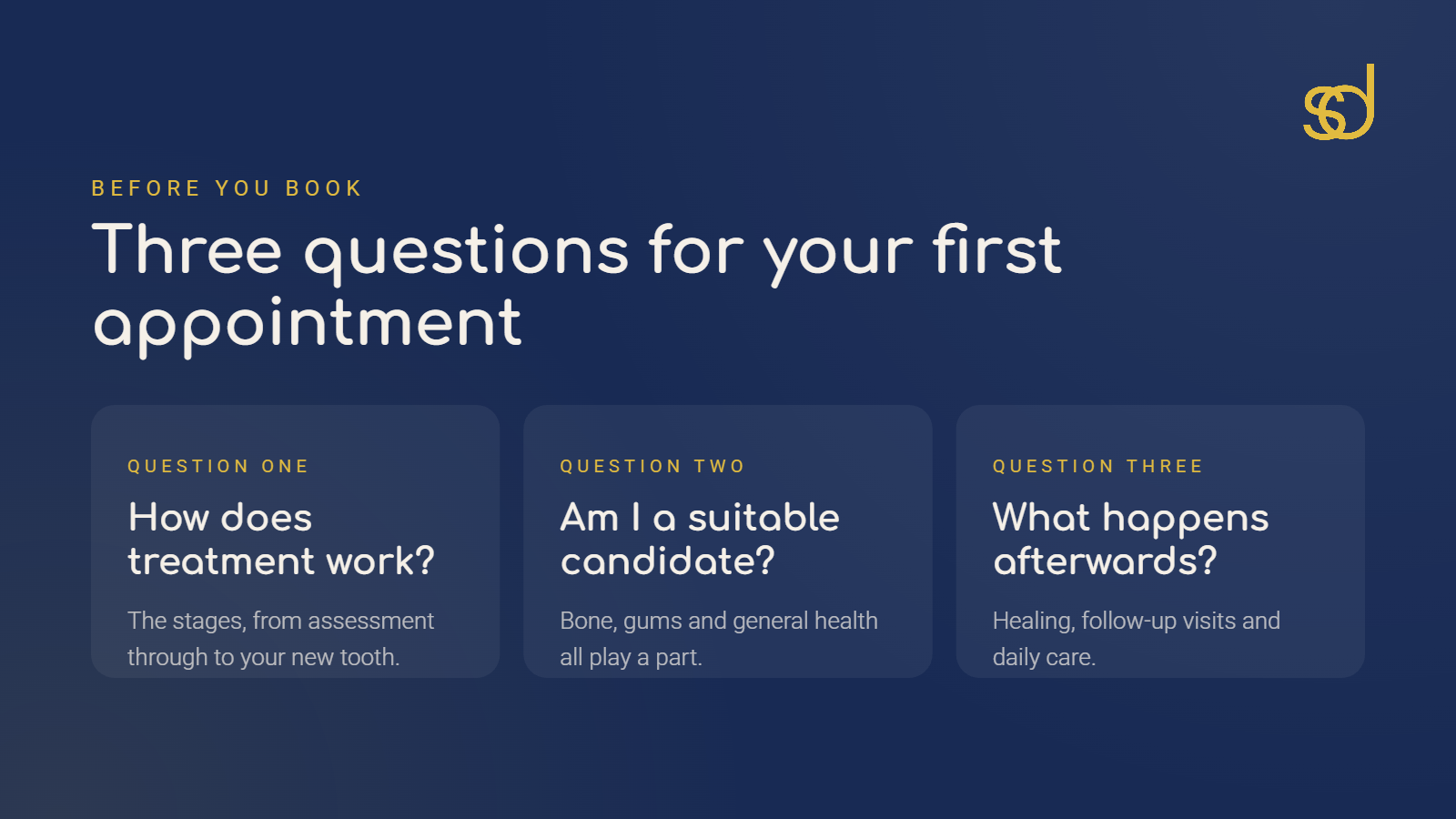
The short answer: a dental implant is a small titanium post placed in the jawbone to support a replacement tooth, and whether it may suit you depends on your bone, your gums and your general health. If you are thinking about implants, three questions can help you get the most from your first appointment: how does treatment work, am I a suitable candidate, and what happens afterwards.
This guide is written for people in Hoppers Crossing, Tarneit, Werribee and nearby suburbs, and follows those three questions in order.
Why the first appointment matters
Implant treatment involves surgery, healing time and ongoing care, so it helps to understand your options before you commit to anything. A first appointment is a chance to ask questions, share your health history and hear how your dentist would approach your situation. You are not expected to decide on the day, and it is reasonable to ask for your options, risks and costs to be explained clearly. Going in with a few good questions makes that conversation easier.
What is a dental implant?
A dental implant replaces the root of a missing tooth. A small titanium post is placed in the jawbone and the bone grows around it. A connector and a crown, bridge or denture is then attached, so the replacement tooth is supported by the implant rather than by the teeth beside it. You can see how we approach treatment on our dental implants page.
Question one: how does treatment work?
Every plan is different, but implant treatment generally follows these stages:
- Assessment. Your dentist reviews your medical history, examines your teeth and gums, and uses imaging such as digital X-rays or an OPG to look at your jawbone.
- Placement. The implant is placed in the jaw in a minor surgical procedure, usually with local anaesthetic. If you feel anxious, ask about sedation dentistry.
- Healing. Bone needs time to grow around the implant. Healthdirect and the Australian Dental Association both describe about three months, although timeframes vary.
- Your new tooth. Once healing has been assessed, the crown, bridge or denture is attached and the bite is checked.
Question two: am I a suitable candidate?
Not everyone is. Your dentist will look at several things before recommending treatment:
- Jawbone: there needs to be enough healthy bone to hold the implant.
- Gum health: gum disease usually needs to be treated first. Our periodontal care page explains how gum disease is managed.
- General health: conditions such as diabetes, osteoporosis and bleeding disorders, and some medications, can affect healing.
- Smoking: smoking is linked to a higher risk of complications.
Our patients come from Hoppers Crossing and surrounding suburbs, including Tarneit, Werribee and Truganina. Wherever you are coming from, suitability is confirmed after a clinical assessment.
Question three: what happens afterwards?
Implants still need daily care. The Australian Dental Association advises brushing twice a day, cleaning between your teeth every day, and keeping up regular check-ups and professional cleans. Ask your dentist how to clean around your implant, and what follow-up visits to expect while you heal.
What are the risks of dental implants?
All surgery carries risk. Healthdirect lists infection, nerve damage, sinus problems and damage to nearby teeth as possible complications. The Australian Dental Association also notes that implants can develop peri-implantitis, a gum condition causing inflammation and bone loss that, if untreated, can lead to an implant becoming loose. Outcomes vary, and your dentist should explain the risks, benefits and alternatives before you decide.
What if implants are not suitable for me?
Being told implants may not suit you is not the end of the conversation. Other options include dentures and crowns and bridges, each with its own trade-offs. Healthdirect explains the different types of dentures. If you are missing most of your teeth, you may also like to read about All-on-X dental implants, which is designed to replace a full arch with fixed teeth.

What to bring to your first appointment
- A list of your medications and any relevant medical reports.
- Your health fund details. You can also complete our medical history form beforehand.
- Your questions, including the three above.
- A family member or friend, if you would like some support.
Costs and payment
Costs depend on your plan, so they are explained after your assessment. Details of the options available are on our payment plans page.
Frequently asked questions about dental implants
Will treatment be uncomfortable?
Local anaesthetic is normally used for implant surgery. Healthdirect notes that bruising, swelling and some pain can follow the procedure, and your dentist will explain aftercare and pain relief options.
How long does the whole process take?
It varies. Healing of about three months is commonly described before the final tooth is attached, and your plan may add time for assessment, gum treatment or other preparation.
Am I too old for dental implants?
Age alone does not decide suitability. Overall health matters most. Healthdirect lists age over 60 among the factors that can increase the risk of complications, so your dentist will consider your whole health picture.
Can I have implants if I smoke?
Smoking is linked to a higher risk of complications and can affect healing. Your dentist can talk through what this means for you and what support is available.
Do I need sedation for implant treatment?
Not necessarily. Local anaesthetic is normally used, and sedation may be an option if you feel anxious. You can read more about sedation dentistry at Sayers or sleep dentistry.
Ready to ask your questions?
If you would like to discuss whether dental implants may suit you, you can request an appointment online or call us on (03) 9749 1178. You can also meet the Sayers Dental team before you visit.
General information only. This article is not a substitute for advice from a registered health practitioner. Suitability for any treatment is confirmed after a clinical assessment, and all treatment carries risks and benefits. Outcomes vary. If you have concerns about your health, speak with your dentist or doctor.
Written by the Sayers Dental team.